The 2023 NICE K12 Cybersecurity Education Conference Planning Committee is announcing an extension of the deadline for its Call for Proposals to accommodate educators who have requested us to provide more time given their summer schedules and the July 4th holiday. The Planning Committee is seeking timely and thought-provoking K12 cybersecurity education topics that will challenge and inform educational leaders from across the stakeholder community.
They encourage proposals from a diverse array of organizations and individuals with different perspectives, including K12 educators, school counselors, students, institutions of higher education faculty, employers and practitioners, non-profits, curriculum providers, research centers, and training and certification providers. Topics should support one or more of the National K12 Cybersecurity Education Implementation Plan components and align with one of the five conference tracks:
1. Increasing Cybersecurity Career Awareness 2. Infusing Cybersecurity Across the Education Portfolio 3. Integrating Innovative Cybersecurity Educational Approaches 4. Designing Cybersecurity Academic and Career Pathways 5. Promoting Cyber Awareness
The NICE K12 Cybersecurity Education Conference takes place on December 4-5, 2023, at the Hilton Phoenix Resort at the Peak in Phoenix, Arizona.
Act now – Submissions close on July 28, 2023 at 11:59pm PST.
The Microsoft security operations analyst collaborates with organizational stakeholders to secure information technology systems for the organization. Their goal is to reduce organizational risk by rapidly remediating active attacks in the environment, advising on improvements to threat protection practices, and referring violations of organizational policies to appropriate stakeholders.
Explore core AI concepts at Azure Virtual Training Day: AI Fundamentals from Microsoft Learn. Join us for this free training event to learn how organizations use AI technology to solve real-world challenges and see how to build intelligent applications using Azure AI services. This training is suitable for anyone interested in AI solutions—including those in technical or business roles. You will have the opportunity to: Understand foundational AI concepts and real-world use cases. Get started using AI services on Azure and machine learning in Azure Machine Learning Studio. Identify common AI workloads and ways to use AI responsibly. Join us at an upcoming event: Wednesday, July 26, 2023 | 2:00 PM – 5:30 PM | (GMT-05:00) Eastern Time (US & Canada)
Delivery Language: English Closed Captioning Language(s): English
In today’s digital age, cloud computing has become an essential part of businesses, enabling them to store and access their data from anywhere. However, with convenience comes the risk of data breaches and cyberattacks. Therefore, it is crucial to implement best practices to secure data in cloud services.
1. Choose a reliable cloud service provider
Choosing a reputable cloud service provider is the first step toward securing data. The provider should offer secure data storage, encryption, and access controls. Look for providers that are compliant with relevant security standards and regulations, such as ISO 27001, HIPAA, and PCI DSS. Microsoft Cloud has several certifications making it a trusted choice for customers. For an exhaustive list of the compliance offerings, refer to compliance offerings for Microsoft 365, Azure, and other Microsoft services.
2. Understand your security responsibilities
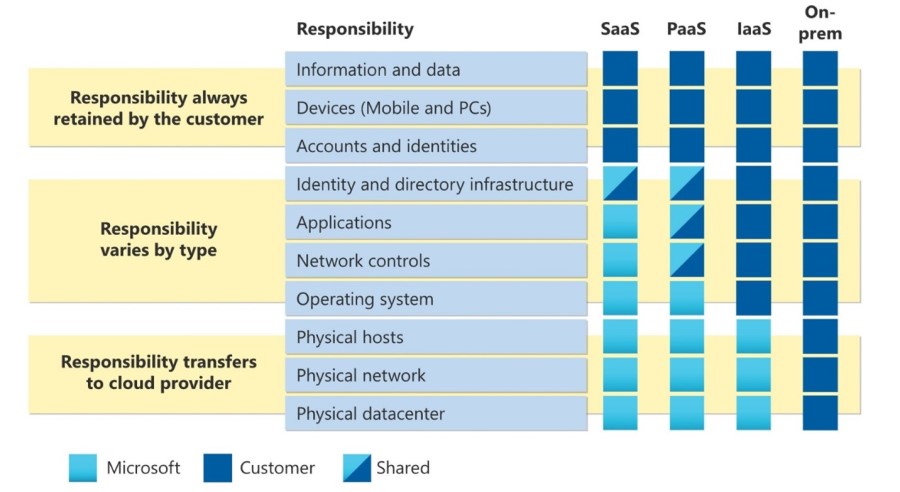
When you move your data to cloud services, it’s important to understand who is responsible for securing it. In most cases, the cloud provider is responsible for securing the infrastructure, while the customer is responsible for securing the data stored on that infrastructure. Make sure you know your responsibilities and take the necessary steps to secure your data. The below picture shows how the responsibility shifts from the customer to the cloud provider as the customers move their applications to cloud services. While customers maintain end-to-end responsibility of maintaining the environment on-premises, as they move to cloud services, more and more responsibilities are taken over by the cloud provider. However, maintaining and securing data, devices, and identities is always the customer’s responsibility.
Figure 1. Shared responsibility model in the cloud.
3. Use strong authentication
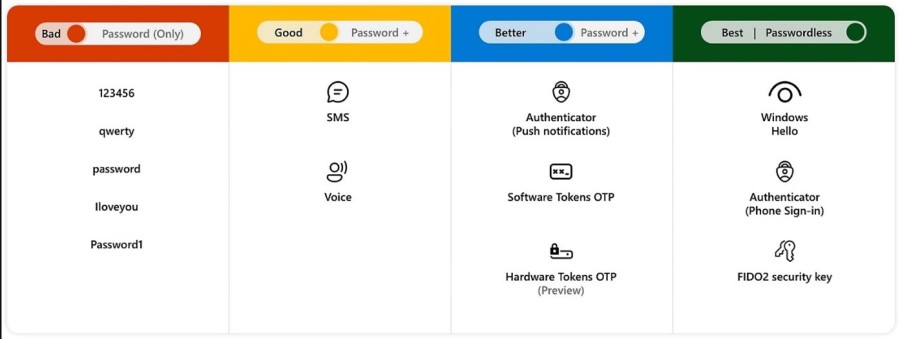
While passwords are the first line of defense against unauthorized access, we are aware that passwords can be stolen, leaked, or compromised. Using strong authentication methods, such as multifactor authentication, can significantly reduce the risk of unauthorized access to data. Multifactor authentication requires users to provide multiple forms of authentication, such as a password and a code sent to a mobile app, before gaining access to the cloud environment. However, the best defense is provided by passwordless technologies like facial recognition, fingerprints, or mobile apps. Microsoft provides a host of such technologies like Windows Hello, Microsoft Authenticator, or FIDO2 Security keys. Using these methods, you can mitigate the risk of password theft.
Figure 2. Authentication methods.
4. Implement encryption
Encryption is a critical component of cloud security. It involves encoding data in such a way that only authorized users can access it. Implementing encryption for data in transit and data at rest can help protect sensitive data from unauthorized access and data breaches. In the Microsoft Cloud, data is always encrypted at rest, in transit, and in use. Microsoft Azure Storage Service Encryption provides encryption for data at rest with 256-bit AES using Microsoft Manage Keys. It encrypts data in Azure Managed Disks, blob storage, Azure files, Azure queues and table storage. Azure Disk Encryption provides encryption for data at rest in Windows and Linux VMs using 256-AES encryption. Transparent Data Encryption provides encryption for Microsoft Azure SQL Database and Azure Data Warehouse.
5. Protect data wherever it lives or travels
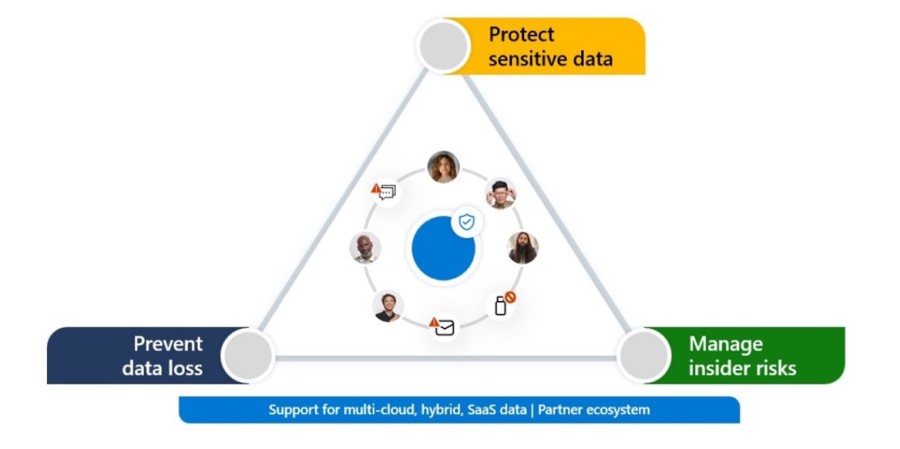
The biggest problem faced by businesses today is discovering where their sensitive data is. With more than 80 percent of corporate data “dark”, organizations need tools to help them discover this data. Microsoft Purview Information Protection helps you scan data at rest across Microsoft 365 applications, SharePoint Online, Exchange Online, Teams, non-Microsoft Cloud apps, and on-premises file shares and SharePoint servers using the Microsoft Purview Information Protection scanner tool, to discover sensitive data. Identifying the data is not enough. Organizations need to be aware of the risk associated with this data and protect the data by applying things such as encryption, access restrictions, and visual markings. With Microsoft Purview Information Protection you can automatically apply sensitivity labels to identify the data as highly confidential, confidential, or general, depending on your label schema by using more than 300 Sensitive Information Types and Trainable Classifiers.
Organizations also suffer from inadvertent or malicious data loss. They need to have controls in place to prevent sensitive data from being accessed by unauthorized individuals. Microsoft Purview Data Loss Prevention helps prevent data loss by identifying and preventing risky or inappropriate sharing, transfer, or use of sensitive information across cloud, apps, and on endpoint devices. It is a cloud-native solution with built-in protection so that you no longer need to deploy and maintain costly on-premises infrastructure or agents.
Data doesn’t move itself; people move data. That is why understanding the user context and intent behind data movement is key to preventing data loss. Microsoft Purview Insider Risk Management offers built-in, ready-to-use machine learning models to detect and mitigate the most critical data security risks around your data. And by using Adaptive Protection, organizations can automatically tailor the appropriate data loss prevention controls based on a user’s risk level, ensuring that the most effective policy—such as blocking data sharing—is applied only to high-risk users, while low-risk users can maintain their productivity. The result: your security operations team is now more efficient and empowered to do more with less.
Figure 3. Microsoft’s approach to data security.
6. Implement access control
Implementing access controls can help limit access to sensitive data in cloud services. Access controls should be based on the principle of least privilege, where users are granted the minimum access required to perform their tasks. Role-based access control can be used to assign roles and permissions to users based on their job responsibilities. Microsoft Entra encompasses all such Identity and Access capabilities from Microsoft.
7. Monitor cloud activity and know your security posture
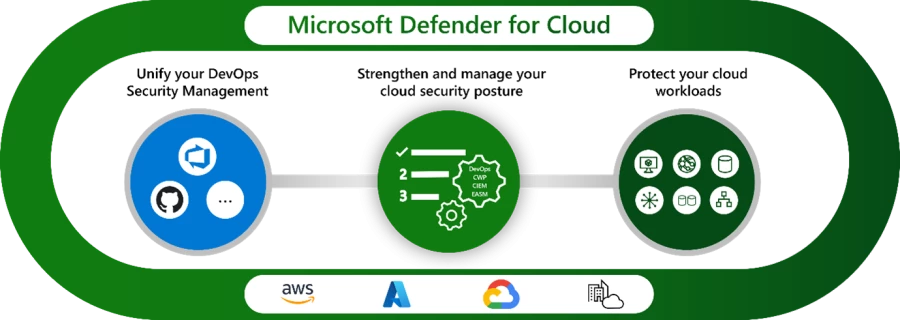
Monitoring cloud activity can help detect and prevent unauthorized access to data. Cloud service providers offer monitoring services that can alert administrators when suspicious activity is detected. Regularly reviewing cloud logs and audit trails can help identify potential security threats. Microsoft Defender for Cloud is a cloud-native application protection platform that combines the capabilities of Cloud Security Posture Management with integrated data-aware security posture and Cloud Workload Protection Platform to help prevent, detect, and respond to threats with increased visibility into and control over the security of multicloud and on-premises resources such as Azure Storage, Azure SQL, and open-source databases.
Figure 4. Microsoft Defender for Cloud.
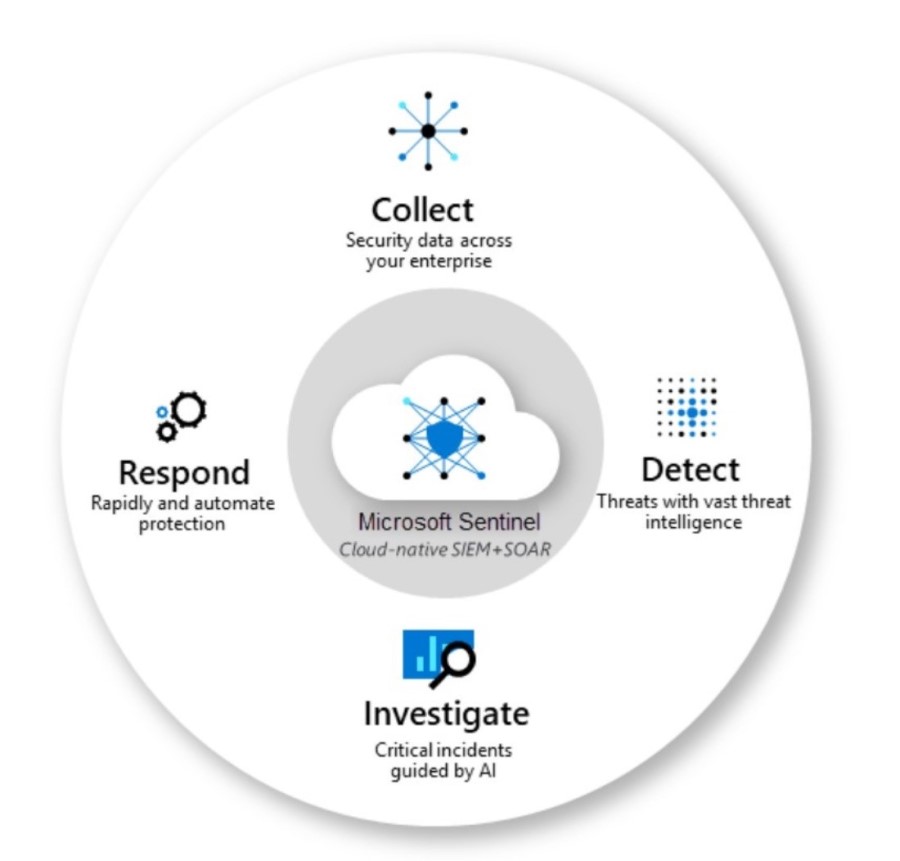
In addition, Microsoft Sentinel, Microsoft’s AI-enriched, cloud-native security information and event management, can uncover sophisticated threats and automate response. It acts as a centralized hub across multicloud environments to monitor attackers as they move across vectors.
Figure 5. Microsoft Sentinel.
8. Use secure APIs
APIs are used to access cloud services, and they can be vulnerable to attacks if not secured properly. Secure APIs should be implemented with strong authentication and encryption to prevent unauthorized access to cloud services.
9. Conduct regular security assessments
Conducting regular security assessments can help identify security vulnerabilities and assess the effectiveness of security measures. Regular security assessments can be conducted internally or by third-party security experts.
10. Train your employees
Ensure that your employees are aware of the security risks associated with storing data in cloud services and are trained on best practices for securing data. This includes regular security awareness training and policies for reporting suspicious activity.
11. Implement principles of Zero Trust
Zero Trust is a security strategy. It is not a product or a service, but an approach in designing and implementing the following set of security principles:
Verify explicitly – Always authenticate and authorize based on all available data points.
Use least privilege access – Limit user access with Just-In-Time and Just-Enough-Access (JIT/JEA), risk-based adaptive policies, and data protection.
Assume breach – Minimize blast radius and segment access.
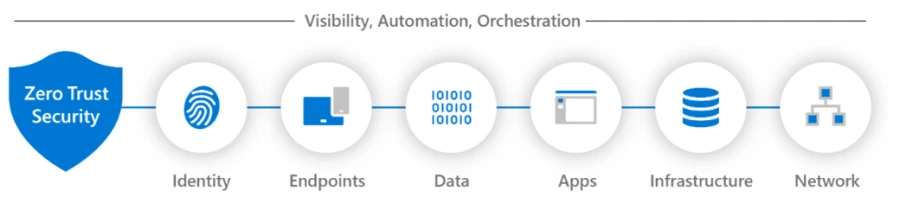
A Zero Trust approach should extend throughout the entire digital estate and serve as an integrated security philosophy and end-to-end strategy. This is done by implementing Zero Trust controls and technologies across six foundational elements of identity, endpoints, data, apps, infrastructure, and network.
Figure 6. Zero Trust across the vectors.
Each of these is a source of signal, a control plane for enforcement, and a critical resource to be defended. Here is Microsoft’s guide to securing data with Zero Trust.
What’s next
In conclusion, securing data in cloud services is essential for businesses to protect their sensitive information from unauthorized access and data breaches. End-to-end security design and implementation is the foundation of securing data in cloud services. Microsoft recommends a defense in depth approach implementing the principles of Zero Trust across identity, endpoints, data, apps, infrastructure, and network.
Learn more
To learn more about Microsoft Security solutions, visit our website. Bookmark the Security blog to keep up with our expert coverage on security matters. Also, follow us on LinkedIn (Microsoft Security) and Twitter (@MSFTSecurity) for the latest news and updates on cybersecurity.
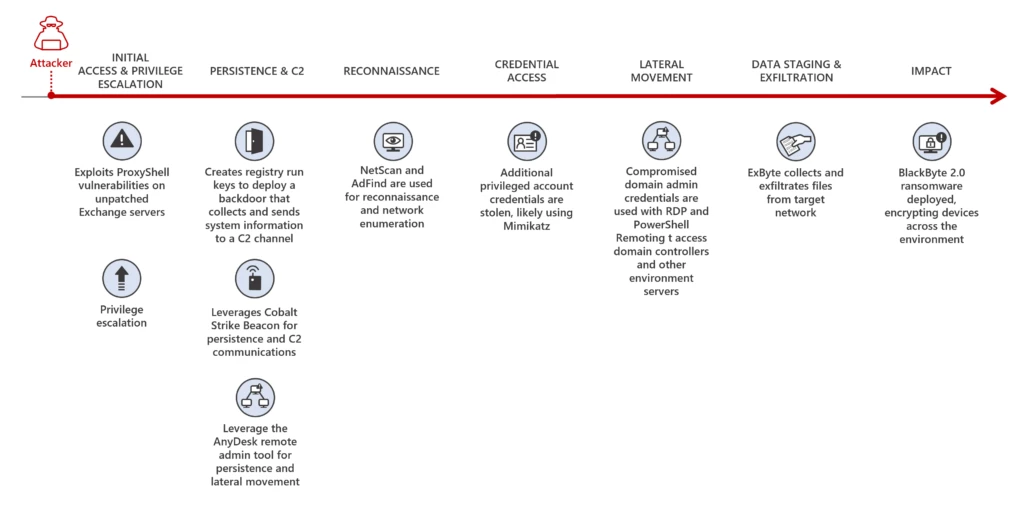
As ransomware attacks continue to grow in number and sophistication, threat actors can quickly impact business operations if organizations are not well prepared. In a recent investigation by Microsoft Incident Response (previously known as Microsoft Detection and Response Team – DART) of an intrusion, we found that the threat actor progressed through the full attack chain, from initial access to impact, in less than five days, causing significant business disruption for the victim organization.
Our investigation found that within those five days, the threat actor employed a range of tools and techniques, culminating in the deployment of BlackByte 2.0 ransomware, to achieve their objectives. These techniques included:
Exploitation of unpatched internet-exposed Microsoft Exchange Servers
Web shell deployment facilitating remote access
Use of living-off-the-land tools for persistence and reconnaissance
Deployment of Cobalt Strike beacons for command and control (C2)
Process hollowing and the use of vulnerable drivers for defense evasion
Deployment of custom-developed backdoors to facilitate persistence
Deployment of a custom-developed data collection and exfiltration tool
Figure 1. BlackByte 2.0 ransomware attack chain
In this blog, we share details of our investigation into the end-to-end attack chain, exposing security weaknesses that the threat actor exploited to advance their attack. As we learned from Microsoft’s tracking of ransomware attacks and the cybercriminal economy that enables them, disrupting common attack patterns could stop many of the attacker activities that precede ransomware deployment. This case highlights that common security hygiene practices go a long way in preventing, identifying, and responding to malicious activity as early as possible to mitigate the impact of ransomware attacks. We encourage organizations to follow the outlined mitigation steps, including ensuring that internet-facing assets are up to date and configured securely. We also share indicators of compromise, detection details, and hunting guidance to help organizations identify and respond to these attacks in their environments.
The Cybersecurity and Infrastructure Security Agency (CISA), the Federal Bureau of Investigation (FBI), the Multi-State Information Sharing and Analysis Center (MS-ISAC), and the Canadian Centre for Cyber Security (CCCS) released this Joint Cybersecurity Advisory in response to cyber threat actors leveraging newly identified Truebot malware variants against organizations in the United States and Canada. As recently as May 31, the authoring organizations have observed an increase in cyber threat actors using new malware variants of Truebot (also known as Silence.Downloader). Truebot is a botnet that has been used by malicious cyber groups like CL0P Ransomware Gang to collect and exfiltrate information from its target victims. Previous Truebot malware variants were primarily delivered by cyber threat actors via malicious phishing email attachments; however, newer versions allow cyber threat actors to also gain initial access through exploiting CVE-2022-31199 —(a remote code execution vulnerability in the Netwrix Auditor application), enabling deployment of the malware at scale within the compromised environment. Based on confirmation from open-source reporting and analytical findings of Truebot variants, the authoring organizations assess cyber threat actors are leveraging both phishing campaigns with malicious redirect hyperlinks and CVE-2022-31199 to deliver new Truebot malware variants. The authoring organizations recommend hunting for the malicious activity using the guidance outlined in the Joint Cybersecurity Advisory, as well as applying vendor patches to Netwrix Auditor (version 10.5). Any organization identifying indicators of compromise (IOCs) within their environment should urgently apply the incident responses and mitigation measures detailed in this joint advisory and report the intrusion to CISA or the FBI.
What’s in a Name? The Tesla Do you enjoy flipping on the light switch or plugging in that favorite electrical device? Well, you can thank Nikola Tesla — born 167 years ago today — for that amazing invention. You may think of Thomas Edison as the main pioneer in electricity. But Nikola Tesla brought us alternating current (AC) electricity, which is the type of electricity that is widely used in our homes and buildings today. As the name implies, alternating current reverses direction at regular intervals, and it turns out that it’s much better for moving electric power over long distances. Read More
Reviewers are encouraged to comment on all or parts of draft NIST SP 800-171, Rev. 3. See the publication details for a copy of the draft and instructions for submitting comments.
Significant changes to draft NIST SP 800-171, Rev. 3 include:
Updated security requirements and families to reflect updates in NIST SP 800-53, Rev. 5 and the NIST SP 800-53B moderate control baseline
Updated tailoring criteria
Increased specificity for security requirements to remove ambiguity, improve the effectiveness of implementation, and clarify the scope of assessments
Introduction of organization-defined parameters (ODP) in selected security requirements to increase flexibility and help organizations better manage risk
A prototype CUI overlay
Comments received in response to this request will be posted on the Protecting CUI project site after the due date. Submitters’ names and affiliations (when provided) will be included, while contact information will be removed.
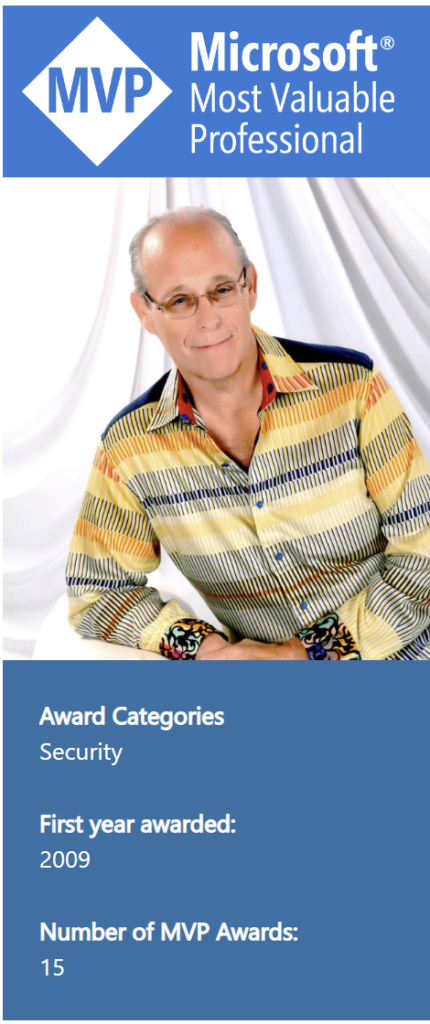
We’re pleased to present you with the Microsoft Most Valuable Professional (MVP) award in recognition of your exceptional leadership. We’re recognizing your outstanding contributions to the technical community in:
Explore core AI concepts at Azure Virtual Training Day: AI Fundamentals from Microsoft Learn. Join us for this free training event to learn how organizations use AI technology to solve real-world challenges and see how to build intelligent applications using Azure AI services. This training is suitable for anyone interested in AI solutions—including those in technical or business roles. You will have the opportunity to: Understand foundational AI concepts and real-world use cases. Get started using AI services on Azure and machine learning in Azure Machine Learning Studio. Identify common AI workloads and ways to use AI responsibly. Join us at an upcoming event: Wednesday, July 26, 2023 | 2:00 PM – 5:30 PM | (GMT-05:00) Eastern Time (US & Canada)
Delivery Language: English Closed Captioning Language(s): English